When I studied chemistry in college I used to go home and talk to my grandfather (who’s an engineer) about what I had learned that day. However, when it came to the mole, I found myself pausing mid- sentence to mentally check to see if every detail was correct; this was because it seemed like whenever I thought I remembered everything about this deceptively tricky topic – there was a minute detail that could prove costly if omitted or misunderstood in an exam.
So, in this post I’m going to be running through what the mole is; why we use it as a measurement; how to calculate the amount of a substance in moles and how it relates to mass – plus the number known as Avogadro’s number.
What is the mole?
The mole is an SI unit that expresses a measurement of the amount of a substance (which could consist of atoms, molecules or ions). The first thing to note is that when we say ‘amount’ we don’t mean the same thing as ‘mass’. The amount of a substance refers to the number of particles – whether that’s atoms, ions or molecules – present in a sample, whereas the mass is a measurement of how heavy a sample of a substance is.
So for instance if we have 50g of magnesium chloride, that means that we have a sample of magnesium chloride that has a mass of 50g, but the amount of the substance present would be a measurement of the number of ions of magnesium and chloride present in the sample.
Or – for a slightly more tasty analogy – if you had a piece of Victoria sponge cake (illustrated below) and that piece of cake contained 40g of sucrose (table sugar), the mass would be 40g, but the amount as expressed in moles would refer to the number of sucrose molecules present in the cake.

I actually made the cake pictured and I may have thought about the number of moles present – but then realised I only had about 20 minutes to make it for a party, so mole calculations had to be put on hold.
Okay, let’s now delve into the portion of this topic that caused myself and my college peers a bit of a headache when we were first introduced to it . I’m referring to Avogadro’s Number.
Avogadro’s Number/Avogadro’s Constant
6.02 x 10 23
The number above is crucial in the world of the mole. This number indicates how many particles are present in 1 mole of a substance. Let’s briefly explore that number.
It is written in standard form or scientific notation, which is a way of expressing either a really small number or a very large number – and in this example it’s a very large number. (I won’t go into too much detail about standard form in this post – but please leave a comment if you want me to produce a tutorial on standard form.)
The number if written out using the decimal numeral system would look like this: 602 000 000 000 000 000 000 000
This is 602 hexillion and if we were to write it out in decimal form every time we had a mole of something, it would take up quite a lot of time and paper. So, instead we express it as a multiplier in 3 significant figures of 6.02 followed by a multiplication sign and a base of 10 to the power of 23.
However, if you were to type into a search engine the phrase ‘Avogadro’s number’ you would get a number beginning with 6.02, but then various other numbers before you get to the multiplication sign. This is the true value of Avogadro’s number, however we round the number to 3 significant figures, as is common practice in chemistry – which we will see when we do some calculations in a bit. It’s a similar situation to pi which is expressed as 3.14, rather than writing more of the infinitesimal number of figures.
Avogadro’s Number was named after an Italian physicist named Amedeo Carlo Avogadro. Avogadro was known for his work on the behaviour of molecules of gases at different temperatures and pressures and devised Avogadro’s law. (I’ll discuss Avogadro’s law in another post.)
But why is Avogadro’s number part of a principle known as Avogadro’s constant? It’s because one mole of a substance – no matter what that substance is – contains the same number of particles as there are atoms in 12g of the Carbon-12 isotope – which is 6.02 x10²³. (We’ll get to Carbon-12 in a bit.)
So, let’s say we have 1 mole of carbon dioxide (CO2) molecules, in that sample we will have 6.02 x 10²³ molecules of carbon dioxide.
Alternatively, for the sake of dietary balance because we used cake as an example earlier on, if we had 1 mole of apples we would have 6.02 x 10 23 apples – which would probably be enough to run a pretty successful cider business.
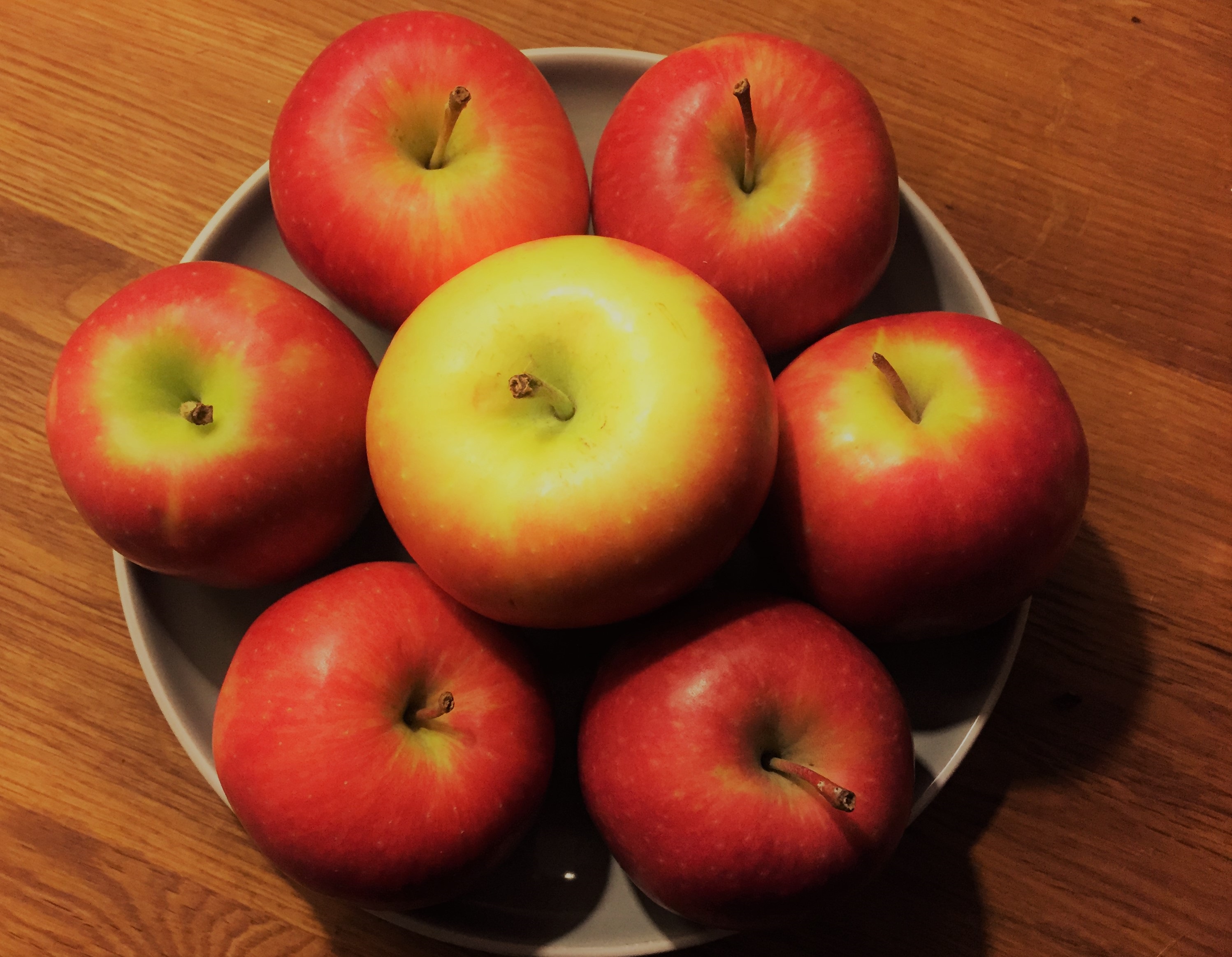
Anyway, the point is that whenever you have 1 mole of anything, you have 6.02 x 10²³ particles of that substance – hence the phrase Avogadro’s Constant.
Why do we measure in moles?
The main reason why the mole is used as a measurement in chemistry is because it provides an internationally recognised practical way of calculating and recording the amount of a chemical substance.
If the mole wasn’t used as a measurement, there wouldn’t be a pragmatic way of measuring and recording the amount of a substance; for instance, if we wanted to note the amount of water we needed as a reactant, it would be practically impossible to count 6.02 x 10²³ molecules of water. (Multiple generations of people would have to dedicate themselves to the cause and you would need a means of seeing the diminutively sized molecules.) So, the mole tends to do a lot of the work for us.
Okay, now we have to address how mass influences the calculation of the amount of a substance in moles
I’m going to use a definition of a mole that you will see written in textbooks and you’ll need to remember for exams.
One mole of a substance contains the same number of particles as there are atoms present in 12g of Carbon-12.
What this statement refers to is that when you calculate the number of moles of Carbon-12 atoms present in a 12g sample of Carbon-12, the answer will be 1 mole.
Let’s see how that comes about.
Calculating the Number of Moles Present using Mass
Okay, the word ‘mass’ is going to be used in this section within four definitions that are crucial to know – but I’ll explain them within a table to make it a bit easier to explain.
| Variable | Definition |
| Relative Atomic Mass | The weighted average mass of an atom of an element compared to 1/12 of the mass of one atom of Carbon-12. No units. ‘Weighted’ refers to the inclusion of the masses and relative abundances of all the isotopes of the particular element when calculating its relative atomic mass. Typically rounded to 3 or 4 significant figures and expressed for each element in the periodic table. |
| Relative Isotopic Mass | The mass of one atom of an isotope of an element compared to 1/12 of the mass of one atom of Carbon-12. No units. |
| Relative Formula Mass | The sum of the relative atomic masses of the atoms/ions present in a compound. No units. |
| Molar Mass | The mass of one mole of a substance. Given in the units of g mol-1. |
What is an isotope?
The term ‘isotope’ refers to an atom of an element that has a different number of neutrons present in its nucleus than other atoms of that element meaning it will have a different mass number, but has the same number of protons and electrons as other atoms of that element as indicated by a mutual atomic number.
Mass Number vs Isotopic Mass vs Relative Isotopic Mass
The mass number is a unitless value that represents how many nucleons (protons and neutrons) are present in the nucleus of a given atom of an element which varies between different isotopes of an element due to having different numbers of neutrons. Isotopic mass refers to the actual mass of an isotope in unified atomic mass units (amu) or Daltons (Da) whereas relative isotopic mass is a unitless value that represents how much heavier the isotope is compared to 1/12 of the mass of Carbon-12 (the most abundant isotope of Carbon).
Why do we use unified atomic mass units or Daltons rather than grams?
Due to the tiny size of atoms and their constituent sub-atomic particles, you would need a ridiculously large quantity of atoms to make up 1 gram of mass and it would be extremely difficult to measure accurately. Therefore, its much easier to use specific units from a scale in which the mass of every atom/isotope is based on how it compares with the mass of one atom of a particular isotope: Carbon-12. Just for clarity, 1 unified atomic mass unit (amu) and 1 Dalton (Da) are equal.
Why 1/12 of the mass of Carbon-12?
1/12 of the mass of Carbon-12 is equivalent to 1 amu or 1 Da, therefore this is used as a benchmark for the scale used to determine the comparative mass of an isotope (relative isotopic mass) or the comparative average mass of an atom of an element (relative atomic mass). It’s a bit clearer when we use an example.
Example of Mass Number, Isotopic Mass, Relative Isotopic Mass and Relative Atomic Mass Using the Carbon-12 Scale
Mass Number of Carbon-12 is 12 (6 protons and 6 neutrons)
1/12 of the mass of Carbon-12 = 1 amu or 1Da.
The isotopic mass of Carbon-12 = 12 x 1 amu or 1 Da = 12 amu or 12Da.
Oxygen-16:
Mass Number of Oxygen-16 is 16 (8 protons and 8 neutrons)
Isotopic Mass = ~15.99 amu or ~15.99 Da (to 4 significant figures)
Relative Isotopic Mass = ~15.99 meaning its ~15.99 times heavier than the mass of 1/12 of Carbon-12 (1 amu or 1Da). However, for most specifications, the relative isotopic mass is expressed as a whole number, therefore the relative isotopic mass of Oxygen-16 would be ~16, meaning it is ~16 times heavier than the mass of 1/12 of Carbon-12.
Oxygen (Oxygen-16, Oxygen-17 and Oxygen-18):
Relative Atomic Mass: ~16.00 (to 4 significant figures), indicating that an average atom of oxygen is ~16.00 times heavier than the mass of 1/12 of Carbon-12.
I won’t go through a relative atomic mass calculation in this post, but if you want me to go through the process in another post please leave a comment.
Relative Formula Mass vs Relative Molecular Mass
In addition to relative formula mass, you may also see or hear the phrase ‘relative molecular mass’. This is the sum of the relative atomic masses of atoms present in a molecule – but it does not refer to ionic compounds, whereas relative formula mass can be used to refer to both molecules/covalent compounds and ionic compounds.
Mole Calculations Using Relative Formula Mass and Molar Mass
So let’s prove that 12g of Carbon-12 contains 1 mole of Carbon-12 atoms. To do that we need the formula for working out the number of moles present.
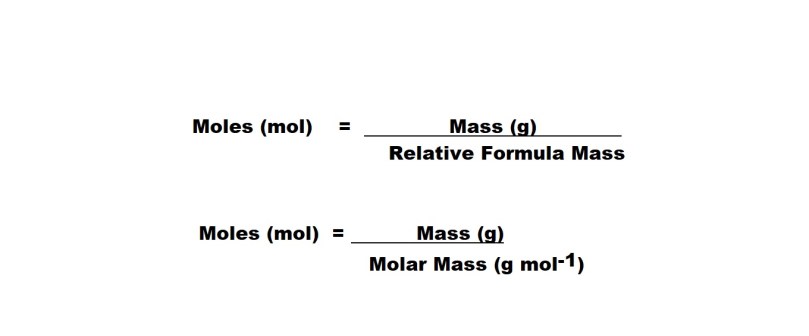
I know – there’s two formulas rather than one; there is a good reason for this. Some exams will allow you to calculate the amount of a substance in moles using relative formula mass – however in other exams you could be asked to define molar mass and then use that as a variable in calculating the number of moles. I would advise that you ask your teacher or lecturer whether to use relative formula mass or molar mass for your upcoming exams.
The calculations featured in this tutorial will not involve the use of conversion factors. I will write a separate accompanying piece featuring calculations involving the use of conversion factors.
You will need a copy of the periodic table to perform mole calculations.
You should round your answer to the same number of significant figures as there are in the value of the variable with the fewest significant figures in the question.
Example of a Mole Calculation using Carbon-12
Using Relative Formula Mass
Mass of Carbon-12 = 12.0g
Mr = 12.0
12.0g / 12.0 = 1.00 mol C-12
Using Molar Mass
Mass of Carbon-12 = 12.0g
M = 12.0 g mol -1 C-12
12.0g / 12.0 g mol -1 = 1.00 mol C-12
Key
Mr: Relative Formula Mass
M: Molar Mass
You can see in the above calculation that the relative formula mass and molar mass are equal in numerical value, yet they differ in meaning and in the presence of units. However, using both formulas, we have proven that one mole of Carbon-12 atoms are present in 12g of Carbon -12.
Note how the mass of the sample of Carbon-12 and the relative formula mass/molar mass are equal. This would be the case if we were to have a sample of atoms of an element that was the same mass as the atom’s relative atomic mass – which would mean 1 mole of atoms of that element would be present. This is why it says in textbooks that the relative atomic mass in grams of any element contains one mole of atoms.
Also note that because we only have a sample containing atoms of the Carbon-12 isotope, the relative formula mass and molar mass are equal to the relative isotopic mass of Carbon-12 which is 12.0.
Let’s do one more calculation with another substance before we move on to the final section.
Example of a Mole Calculation using Methane (CH4 )
Using Relative Formula Mass
Mass of CH4 = 3.00g
Mr = 12.0 + (4) (1.01) = 16.04
3.00 g / 16.04 = 0.187 mol CH4
Using Molar Mass
Mass of CH4 = 3.00g
M = 12.0 g mol -1 + (4) (1.01 g mol -1 ) = 16.04 g mol-1 CH4
3.00g /16.04 g mol -1 = 0.187 mol CH4
Both the relative formula mass and molar mass in the above calculation were calculated by adding up the relative atomic masses of 1 carbon atom and 4 hydrogen atoms – as indicated in the periodic table.
Note: The number of moles present is expressed in 3 significant figures in the above calculation.
Okay, so now we know what the mole is and how to calculate the amount of a substance in moles. But what if we knew the amount of a substance in moles, but we wanted to know its mass.
Calculating Mass using Moles
Let’s pretend that our lab’s scales are broken and there isn’t another one available for a really important experiment. We know how many moles of a substance we have, but we want to know its mass. What are we going to do? Well, we just have to do a bit of rearranging of a formula we already know.
Mass (g) = Moles (mol) x Relative Formula Mass
Mass (g) = Moles (mol) x Molar Mass (g mol-1)
Once again I’m covering a formula involving relative formula mass and one involving molar mass.
If we wanted to know the mass of a substance, we would just have to make mass the subject (the variable that’s going to be worked out) of the formula. This would involve multiplying the amount of a substance in moles by the substance’s relative formula mass or molar mass. Let’s have an example with carbon dioxide (CO2).
Using Relative Formula Mass
Amount in Moles (mol) = 1.50 mol CO2
Mr = 12.0 + (2) (16.0) = 44.0
(1.50 mol) (44.0) = 66.0 g CO2
Using Molar Mass
Amount in Moles (mol) = 1.50 mol CO2
M = 12.0 g mol -1 + (2) (16.0 g mol -1 ) = 44.0 g mol -1 CO2
(1.50 mol) (44.0 g mol -1 ) = 66.0 g CO2
Key
Mr: Relative Formula Mass
M: Molar Mass
Note: The mass of carbon dioxide is expressed in 3 significant figures.
We have reached the end of this first tutorial. When my college peers and I finally understood the mole, we felt more confident about going forward not only in chemistry but in the other sciences too. Learning about the mole and how it relates to mass involves understanding many small but crucial details. However, once you’ve learned about the mole – learning everything else seems more possible.
In the next tutorial, we’ll go through how to convert between a measurement of the amount of a substance in particles to a measurement expressed in moles and vice-versa using Avogadro’s number.
Bye for now.
All images featured in this post are my own.
 Science and Joe